

AI video generation is moving incredibly quickly.
New models are promising more realistic motion, better consistency and increasingly sophisticated control over images and video. But when you’re using these tools for a real commercial project, the question isn’t simply “Which AI model is the latest?”
It’s:
Which model actually produces the best result for the job?
At Eronka, we decided to put two of the latest AI models to the test Google’s Nano Banana and ByteDance’s Seedance 2 using exactly the same creative brief.
The project came from our work with Luxivana, where we were helping turn a property development into a compelling digital marketing story.
The results made our decision surprisingly easy.
The AI Video Challenge
The client wanted to show audiences the transformation of a real property development from its current state into the finished architectural vision.
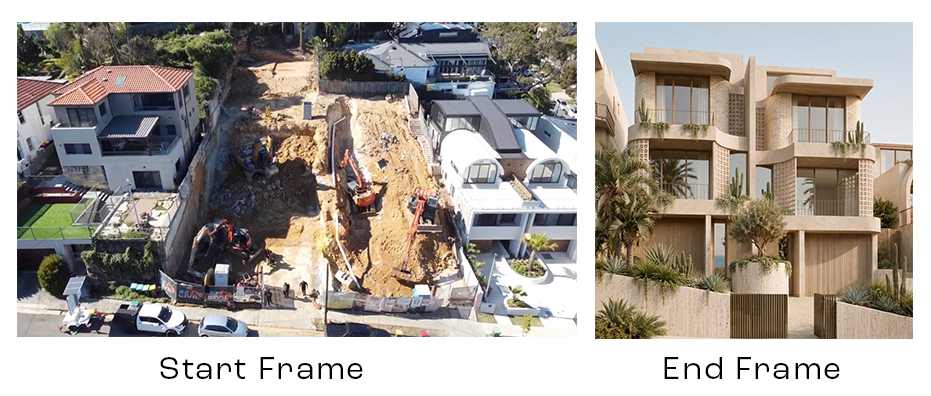
Rather than relying entirely on traditional CGI or creating a completely synthetic AI video, we wanted to combine real-world footage with AI-generated visualisation.
So we started with something very real: a drone.
We sent a drone to the development site and captured aerial footage of the actual location.
We then paired that opening drone shot with the project’s final architectural render.
The challenge was simple:
Could AI create a convincing transition from the real construction site to the finished development?
And, more importantly, which AI video model would do it better?
Same Input. Two AI Models.
To make the comparison as fair as possible, we used the same beginning drone footage and the same final architectural render.
We then tested the creative through two different AI models:
 Google Nano Banana
vs.
ByteDance Seedance 2
The goal wasn’t to produce a scientific benchmark or claim that one model is universally better than another.
Instead, we wanted to understand how each performed against a real commercial creative brief.
And this is where things became interesting.
Google Nano Banana: Impressive, But Not Quite There
Nano Banana produced an impressive result.
The model was able to understand the relationship between the source footage and the architectural vision and create a compelling AI-generated sequence.
For a technology that is developing at such speed, the output was genuinely impressive.
But when we looked at the video through the lens of a client campaign, we wanted more.
We needed the transition to feel natural.
We needed the architecture to remain visually consistent.
And we wanted the finished video to feel like a polished piece of marketing content rather than an AI experiment.
That gave us another model to test.
Seedance 2: The Clear Winner for This Project
We ran the same creative brief through Seedance 2.
The difference was immediately noticeable.
The transition from the real drone footage into the architectural vision felt more convincing and visually cohesive.
The model did a better job of turning the two source images into a continuous visual story rather than simply generating an interesting AI sequence.
For this particular use case, Seedance 2 was the clear winner.
So that’s the version we ultimately used for the client.
Why the Difference Matters
It’s easy to get caught up in AI model benchmarks.
Faster generation.
More parameters.
Better reasoning.
Higher resolution.
But commercial creative work introduces a different set of questions.
Does the output tell the story?
Does it look believable?
Does it represent the client’s product properly?
Would someone stop scrolling to watch it?
And ultimately:
Does it perform?
For this project, Seedance gave us the strongest combination of visual quality and storytelling.
That’s what mattered.
From AI Experiment to Marketing Campaign
The finished video wasn’t created simply to demonstrate what AI could do.
It was built to promote a real project.
Once the creative was ready, we put our paid media buying program behind the campaign.
The campaign ultimately reached more than 500,000 Australians, turning what started as an experiment with emerging AI video technology into a significant piece of marketing content for the client.
That’s the part of AI that excites us most at Eronka.
The technology itself is interesting.
But using technology to create commercial outcomes is far more interesting.
We Don’t Just Build Technology. We Help Tell the Story.
This project is a good example of how we approach our work at Eronka.
We work with businesses to build products, develop digital experiences and integrate emerging technologies.
But building the product is only one part of the equation.
You also need to communicate what you’ve built.
Whether that’s a property development, fintech platform, technology product or new customer experience, businesses need a way to turn something complex into a story people can understand and ultimately act on.
That’s where technology and marketing start to overlap.
In this project, we combined:
Drone cinematography
- Architectural visualisation
- AI video generation
- Creative direction
- Paid media
The result wasn’t just an impressive AI video.
It was a marketing asset designed to get attention and communicate the future vision of a real project.
What We Learned From Comparing AI Video Models
Our biggest takeaway wasn’t necessarily that Seedance is better than Nano Banana.
It’s that there is no substitute for testing AI models against the actual problem you’re trying to solve.
The best AI model isn’t always the one with the biggest announcement or the most impressive benchmark.
It’s the one that produces the right result for your specific application.
And with AI video technology evolving so quickly, that means businesses need to be willing to experiment.
Test.
Compare.
Measure.
And then use what works.
What’s Next for AI Video?
We’re still at the beginning of what’s possible.
AI video models are rapidly improving their ability to understand environments, architecture, movement and visual context.
For industries such as property, construction, architecture, real estate, fintech and advertising, this opens up some particularly interesting opportunities.
Instead of waiting until a project is finished to tell its story, businesses can increasingly show people where they’re going.
That’s a powerful shift.
And it’s exactly why we’re continuing to experiment with emerging AI technologies at Eronka.
Because our role isn’t simply to build what’s possible today.
It’s to help our clients understand what’s possible next and turn it into something commercially useful.
Want to see what AI could do for your product?
At Eronka, we help businesses build products, integrate emerging technology and create the marketing stories that bring those products to life.
If you’ve got a product, project or idea that needs to move from concept to market, let’s build the next chapter together.